
Free, no form to fill in
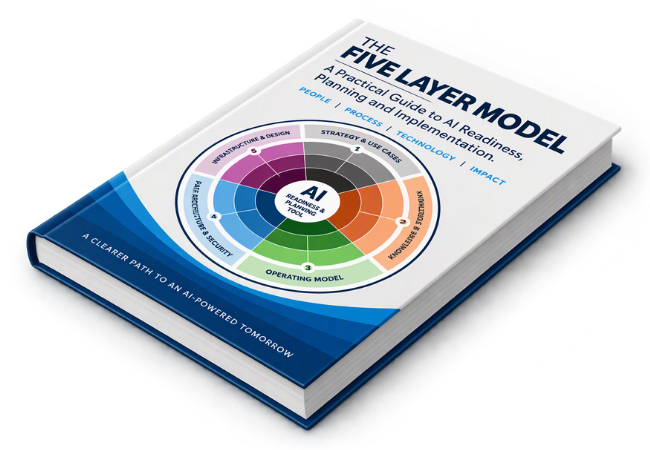
The Five Layer Model™
The model we use to judge whether an organisation is ready for AI, and what to fix first. It looks at strategy, people, processes, data and technology together, because a weakness in any one of them limits the rest.
By Paul Bibby, founder of Orchestrato · About a 15-minute read · Updated October 2026
Why five layers?
Most AI problems aren’t technology problems. A good tool fails when people don’t trust it, when the process it supports is broken, or when the data behind it is poor. The model makes sure every one of those is checked before money is spent.
Read it top to bottom
Start with why AI is being used, then work down through people, processes and data to technology. Technology comes last on purpose.
Five elements in each layer
Each layer breaks into five elements, 25 in all. Each one is a specific thing to check, so the model gives you a to-do list as well as a score.
It goes round, not once
The wheel is a cycle. As you adopt AI, you revisit each layer, because new use cases bring new data, risks and changes to how people work.
Jump to a layer
Layer 1 of 5
Strategy & Use Cases
Is AI being used for the right reasons, where it creates real value?
Defines why AI is being used and where it creates value. It focuses on priority use cases, bias awareness, ethics and governance, so decisions are risk-aware and led by outcomes rather than technology.
| Element | What we look at |
|---|---|
| Feasible | Can we actually do it with our current data, systems and skills? |
| Desirable | Does it solve a real problem that customers or staff want solved? |
| Viable | Is there a business case, with costs and benefits we can measure? |
| Governance | Is there a policy and a clear owner for approving and overseeing AI use? |
| Risk | Have bias, ethics, privacy and regulatory risks been assessed? |
Signs it’s strong
- Use cases are chosen from real problems, then scored and ranked
- Every initiative has an owner and agreed measures
- There is an AI policy people actually follow
Warning signs
- Projects start from a tool someone wants to try
- Nobody can say what AI has delivered
- Staff use AI with no policy or approval
Read: How to prioritise AI use cases →
Read: Shadow AI: the real risks and the controls that work →
Layer 2 of 5
Knowledge & Culture
Do your people have the skills, confidence and trust to use it well?
Addresses human readiness for AI adoption: people capability, communications, trust, tool choice and skills, so AI is understood, accepted and used effectively across the organisation.
| Element | What we look at |
|---|---|
| People | Do leaders sponsor AI and use it themselves? |
| Comms | Is there open, honest communication about what AI means for roles? |
| Attitude | Are people curious about AI, and do they trust it where it’s in use? |
| Skills | Have people had role-based training to use AI safely and well? |
| Ways of Working | Have teams changed how they work to make good use of AI? |
Signs it’s strong
- Leaders talk openly about why AI is being adopted
- Training is specific to roles, not generic
- Teams share what works and what doesn’t
Warning signs
- Licences are bought but usage stays low
- People fear what AI means for their jobs
- A few enthusiasts use AI, and everyone else avoids it
Read: Why Copilot adoption stalls, and what to do about it →
Layer 3 of 5
Operating Model
Are your processes ready to be safely redesigned and scaled?
Examines how work gets done today: process clarity, ownership, variability, friction and change readiness, to judge whether processes are well designed, controlled and ready to be redesigned and scaled.
| Element | What we look at |
|---|---|
| Process | Are key processes documented and understood the same way by everyone? |
| Control | Does each process have an owner and measures that show it’s working? |
| Variability | Do processes run the same way each time, with few workarounds? |
| Change Ready | Is there a proven way to redesign processes and make change stick? |
| Friction | Do you know where manual effort, delays and rework slow things down? |
Signs it’s strong
- Processes have owners, measures and documented steps
- You know where the time and errors are
- Changes are planned, tested and embedded
Warning signs
- The process lives in one person’s head
- Every case is handled differently
- Pilots work but never become how things are done
Layer 4 of 5
Data Architecture & Security
Is your data controlled, classified and fit for AI?
Assesses whether data is controlled, classified and accessible in line with risk and regulation, covering data quality, reporting, access management and the security foundations needed for safe, scalable AI.
| Element | What we look at |
|---|---|
| Data | Do you know what data you hold, where it is and who owns it? |
| Quality | Is it accurate, complete and current enough to rely on? |
| Structure | Is it consistently structured and classified, so systems can use it? |
| Integrity | Can you trace where it comes from and trust your reporting? |
| Access Control | Is access permission-based, reviewed and in line with UK GDPR? |
Signs it’s strong
- Data has owners and a known home
- Sensitive data is classified and protected
- Permissions are reviewed before AI tools are switched on
Warning signs
- The same figures come out differently in different reports
- Shared drives hold years of uncontrolled files
- Nobody is sure who can see what
Read: The biggest risks in AI adoption, and how to avoid them →
Read: Shadow AI: the real risks and the controls that work →
Layer 5 of 5
Infrastructure by Design
Do your technology choices fit the problem you are solving?
Evaluates whether technology choices align to the problem being solved, considering build or buy, user experience, vendor lock-in and architectural flexibility to support value, resilience and future change.
| Element | What we look at |
|---|---|
| Platform | Is technology chosen to fit the problem, rather than the other way round? |
| Secure | Do systems meet recognised security standards, with AI tools vetted before use? |
| Scalable | Could platforms support more users, data and AI workloads without major rework? |
| Managed | Is technology actively managed, with support, monitoring and supplier arrangements? |
| Capacity | Is there in-house or partner capacity to deliver and maintain AI solutions? |
Signs it’s strong
- Requirements come before product choices
- Suppliers are vetted and you could switch if needed
- There is a clear owner for running what is built
Warning signs
- A platform was bought before the problem was defined
- Each team runs its own unconnected tools
- Nobody knows who supports a tool once it’s live
Measuring it
The five maturity levels
Each of the 25 elements is scored from 1 to 5. That gives a score out of 25 for each layer and out of 125 overall, and places you at one of five maturity levels.
| Level | Overall score | What it usually looks like |
|---|---|---|
| High risk | 25 to 44 | AI use is ad hoc or hasn’t started. Little direction, policy or ownership. |
| Tactical | 45 to 64 | Interest and some experiments, but no shared priorities or guardrails. |
| Operational | 65 to 84 | Foundations forming. Gaps in data, process or skills will slow scaling. |
| Strategic | 85 to 104 | AI in use, with ownership and controls. The focus is embedding and proving value. |
| Adaptive | 105 to 125 | AI is part of how you operate. The focus is scaling and improving. |
How to use the model
- Get a baseline. Score all five layers, with more than one leader if you can. Differences in how people score are useful in themselves.
- Find your weakest two layers. They usually limit everything else, whatever your total.
- Fix foundations before scaling. Close the gaps in your weakest layers before extending AI to more teams or more data.
- Check every use case against all five. Before approving an AI idea, ask the question at the top of each layer.
- Reassess every six to twelve months. Track how your scores move as adoption grows.
Questions people ask
Which layer should we start with?
Usually Strategy & Use Cases, because it decides what the other layers need to support. If your scores show a serious gap elsewhere, such as uncontrolled data, fix that first.
Is the model only for large organisations?
No. A small firm uses the same 25 elements, but the answers are lighter: an owner and a one-page policy rather than a committee, for example.
How is this different from a technology maturity model?
Technology is only one of the five layers, and it comes last. Most technology maturity models start there.
Can we use the model ourselves?
Yes. Use this page and the free assessment to score yourselves. The AI Governance Checklist goes deeper on governance and risk.
Where does governance sit?
Mainly in Strategy & Use Cases, through the Governance and Risk elements. It also runs through Data Architecture & Security and Infrastructure by Design, through access control and security.
Keep reading
About the authors
Paul Bibby is the founder of Orchestrato and hosts the Orchestrating AI podcast.
See how your organisation scores
The free AI Readiness Assessment scores all 25 elements in about ten minutes and shows your weakest layers.